
BestOnlyFans built this analysis from subscriber-side cost modeling, so the focus stays on patterns you can measure and interrupt. Zero-dollar entry removes the one decision point that normally forces a budget conversation, then replaces that single decision with dozens of small ones spread across a year. This article traces the mechanical link between free entry and higher lifetime spending using behavioral economics rather than moral judgment. BestOnlyFans refreshes its rankings every month.
Instead of one upfront choice about whether a paid page is worth $9.99, free-page subscribers make repeated per-unlock decisions, pay-per-view messages, paid chat replies, and tips. Each individual decision feels trivial. Aggregated over twelve months across three or four creators, those decisions routinely exceed what a fixed subscription would have cost.

The Psychology of Zero-Dollar Entry Points
The zero-price effect is the starting mechanism. People who would never have paid $8 for a subscription will join a free page immediately, because the mental transaction cost has vanished. That is not irrational on its own, but it shifts the subscriber base toward people who never made a deliberate spending decision.
On a paid subscription, consumption and cost are linked: you pay monthly, you use the page monthly, and both events sit in the same mental frame. On a free page, consumption happens continuously in direct messages while payment happens separately at unlock time. The brain stores these as two unrelated activities, which suppresses the running comparison that normally governs spending.

Once a subscriber has unlocked content, tipped, or built a messaging history, leaving now carries a felt loss. Free entry lowered the barrier to starting and quietly raised the barrier to stopping, which is the mechanism most subscribers never consciously notice.
- Zero-price effect: a $0 page generates far more sign-ups than a $5 page because price becomes a non-decision.
- Payment decoupling: consumption in messages is experienced separately from the moment money leaves the account.
- Sunk cost escalation: prior unlocks get used internally to justify continued unlocking.
- Social proof amplification: direct-message environments make other buyers feel present and normal.
- Scarcity urgency: time-limited PPV offers compress the decision window below the thinking threshold.
How Small PPV Purchases Accumulate Unseen
A single PPV message unlock caps at $50, but most sit far lower, and paid chat commonly runs $3 to $5 per message. Tips can reach $100. The problem is frequency: the same subscriber makes that decision several times a week, across several pages, and no single moment ever feels like the moment to stop.
Notification fatigue is the first visibility killer. Creator-specific siloing makes it worse: money spent on one page is stored separately from money spent on another, so no natural aggregation ever occurs in the subscriber’s head.

Entertainment spending is culturally treated as flexible and guilt-free, so it escapes the scrutiny a recurring monthly bill receives. Platform interfaces reinforce this by design: they show individual unlock confirmations and purchase buttons, not running monthly totals per creator.
| Weekly Pattern | Monthly Projection | Annual Equivalent |
|---|---|---|
| Light: 2-3 unlocks per week | $15-$25 | $180-$300 |
| Moderate: 5-7 unlocks per week | $40-$70 | $480-$840 |
| Heavy: daily unlocks | $100-$150 | $1,200-$1,800 |
| Paid alternative: one mid-tier page | $4.99-$15 | $60-$180 |
- Per-transaction notification fatigue: repeated confirmations stop being read as financial events.
- Spread across payment cycles: charges fragment across statements with no shared line item.
- Creator-specific siloing: each page’s spending sits in a separate mental account.
- Mental categorization as entertainment: not classified as a subscription, so not budgeted like one.
- Interface design: platforms surface unlock prompts, not cumulative monthly spend.
The Multi-Page Multiplier Effect
A subscriber with a $30 mental ceiling for subscriptions might follow eight free pages, because none of those follows triggered the ceiling. Each page then generates its own small stream of PPV offers, paid chat opportunities, and tip prompts. The portfolio of micro-expenses grows while the ceiling that was supposed to govern it stays anchored to subscriptions that never happened.
Paid subscriptions are naturally capped by budget: at $9.99 each, following twenty creators would cost roughly $200 a month, which forces a decision. Free pages remove that natural cap entirely, so the number of active relationships becomes limited only by attention, not by price.

When one creator sends an unlock priced at $12 and another offers something similar at $5, the $5 option feels efficient.
Temporal Discounting and Impulse Unlock Decisions
An unlock prompt offers content in seconds; the cost arrives weeks later on a card statement, stripped of context. In that asymmetry, the immediate reward almost always wins, and it wins faster when the amount is small enough to feel inconsequential.
Urgency messaging exploits the same bias directly. This is standard marketing practice, not deception, but subscribers should recognize that a truncated decision window is a design feature, not a signal about content quality.
Tip: apply a 24-hour rule to any unlock above $10. If the offer expires before you can decide, treat the expiry itself as information about how the offer was priced, not as a reason to buy faster.
There is a practical asymmetry worth naming: paid subscriptions do not pressure you mid-conversation, because the price was settled at sign-up. Many free pages generate most of their revenue precisely because every interaction is a fresh opportunity for a small, immediate, time-pressured decision. If the free onlyfans secret guides you keep reading recommend following ever more pages, note that ranking methodology matters more than the raw count of links.
Comparing True Costs: Free Accumulation Versus Paid Alternatives
An honest cost comparison requires aggregating free-page spending over a fixed period, not estimating it from a single week. Take three months of statements, isolate every PPV unlock, paid chat message, and tip, then total them by creator and overall. Most subscribers who run this exercise find their real monthly number is two to five times their estimate.
Paid base subscriptions run from $4.99 to $49.99, with most pages settling between $4.99 and $15. A $9.99 subscription with messaging included may deliver the same content access that currently costs $60 or more in incremental unlocks. Promotional first months can dip below $4.99, which is a legitimate way to test a page before committing to a base price.

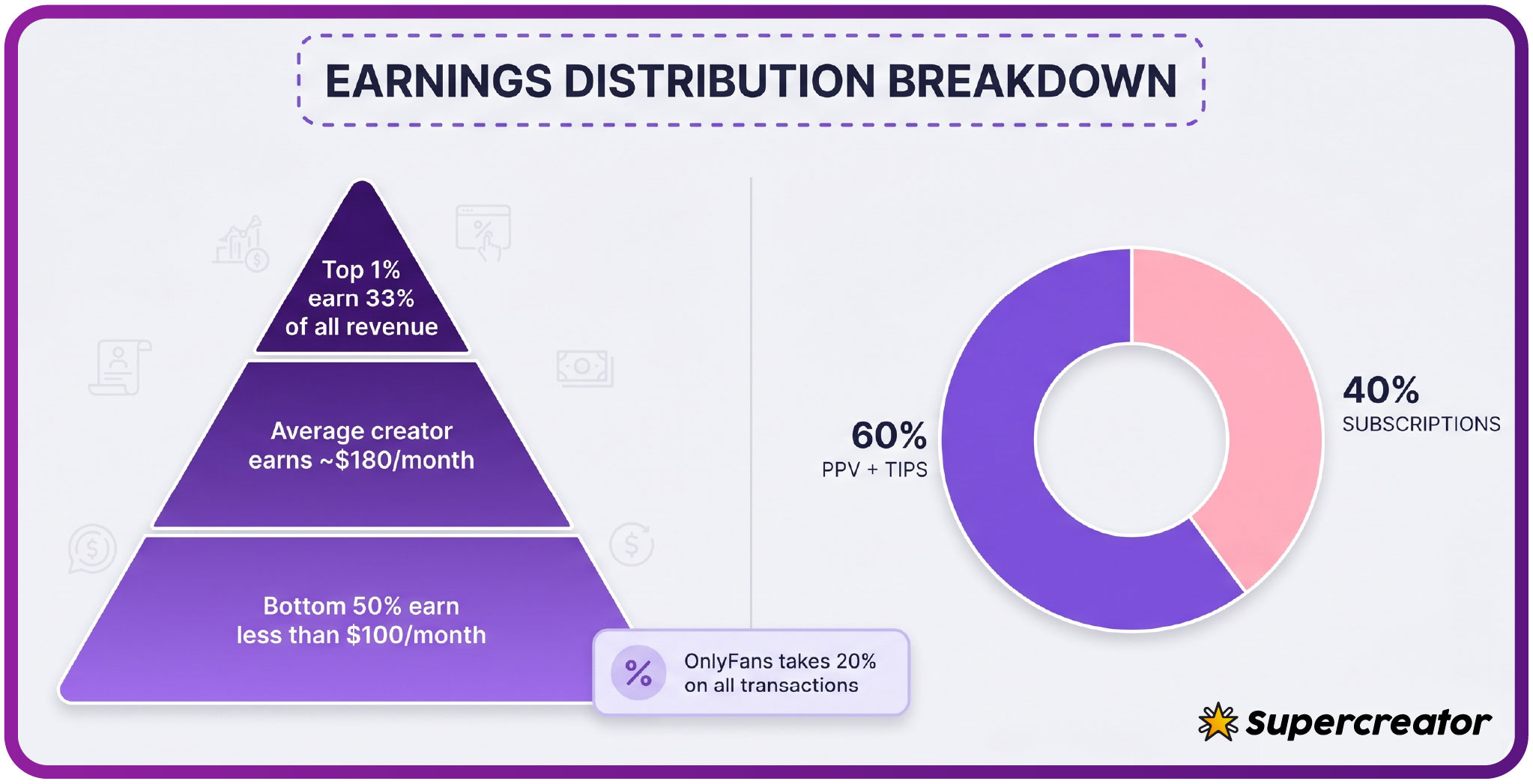
Three mechanics matter when modeling this. The platform takes 20% and the creator keeps 80%, identical on free and paid pages, so your total is unaffected by page type. When a creator raises the price, auto-renew stops and existing access lasts only until the paid period ends. And the $0.10 card verification hold, refunded within days, is a verification step rather than a charge.
| Engagement Profile | Typical Free Page Cost | Paid Equivalent Value |
|---|---|---|
| Casual viewer | $15-$30 per month | Entry paid tier at $4.99-$9.99 |
| Regular consumer | $50-$80 per month | Mid-tier with messaging included |
| Engaged follower | $100+ per month | Premium tier or several curated subscriptions |
- Spending ceiling certainty: paid pricing is fixed and known; PPV is open-ended.
- Content volume predictability: subscriptions deliver steady access; unlocks depend on offers.
- Creator relationship depth: paid pages often include messaging that free pages charge for.
- Decision time: one choice per month versus dozens of micro-choices per week.
- Monitoring cost: paid billing is one line item; PPV requires manual aggregation.
Intervention Points for Spending Pattern Disruption
Setting a personal rule that any unlock above $10 requires a day of consideration inserts a delay exactly where temporal discounting is strongest.
If your monthly ceiling is $40, then a rough maximum of four actively spending pages keeps average exposure controlled. Automated account pauses at a defined threshold, and simple environment cues like a visible budget note, close the loop.

- Weekly spending review: a fixed ten-minute session to total all unlocks and messages.
- 24-hour consideration rule: mandatory delay for any PPV unlock over $10.
- Creator following limit: tie the number of active pages to a monthly budget cap.
- Monthly aggregation email: send yourself a written total so it exists outside your memory.
- Environmental cue: keep current budget status visible while browsing.
- Automated pause threshold: stop spending mechanically when a limit is reached.
Account safety and spending control both depend on the same environment, so tightening one tends to tighten the other. A subscriber who tracks spending in one place and ignores account security in another leaves half the exposure unmanaged.
When Zero-Dollar Entry Genuinely Serves Subscriber Interests
The variable that matters is whether your spending decisions are deliberate and monitored, or automatic and invisible.
Specific-content seekers, budget-constrained users with strong impulse control, and subscribers evaluating a creator before committing to a paid tier all benefit from $0 entry.
- Sporadic consumption: infrequent, unpredictable interest that no monthly billing should cover.
- Targeted access: occasional content needs met efficiently through single unlocks.
- Strong impulse control: subscribers who already monitor totals and stay under budget.
- Extended evaluation: sampling a creator’s style before paying for a subscription.
The deciding question is not whether a page is free, but whether you know your total. If you can state your monthly spending across all pages without checking, free entry is likely working in your favor. If you cannot, the arithmetic in this article applies to you, and a deliberate paid subscription in the $4.99-$15 range is usually the cheaper structure. BestOnlyFans treats that comparison as the core of its ranking work.
FAQ
Why does $0 entry often lead to higher total spending than paid subscriptions?
Each unlock is individually easy to approve, and the totals are never surfaced as one number. The platform fee of 20% applies either way, so the difference comes entirely from the number and frequency of decisions you make.
How can I track spending across multiple free pages accurately?
Work from statements rather than memory. Pull three months of payment records, tag every PPV unlock, paid chat message, and tip by creator, then total them. Per-transaction notifications are unreliable because they stop registering as financial events after repetition, which is exactly why a written aggregation is necessary.
What warning signs indicate my free page engagement is becoming costly?
Any two of these together usually means free entry is functioning as a pricing structure rather than a saving.
When is it rational to switch from free to paid tier with the same creator?
When your aggregated monthly spending on that page exceeds the paid price and your consumption is steady rather than occasional. Paid tiers commonly run $4.99 to $15 and often include messaging that free pages charge for per message. If your spending is predictable and repetitive, a fixed price converts an open-ended cost into a known one, and note that auto-renew stops if the creator later raises the price.